Snowflakes (generative)
December 24, 2020
·
5 min read
Load packages
library(plotrix)
library(gsl)
library(RColorBrewer)
library(data.table)
Set the background of the graphics device to black and generate a vector of colours.
par(bg = "black")
colours <- brewer.pal(10, "Set3")
Make necessary functions
A regular polygon of n sides
By default, this function draws the polygon and returns a data.table with the corresponding x and y coordinates.
draw_regular_polygon <- function(centre.x, centre.y, radius = 0.1, n_sides = 6, rotation = 0, return = TRUE, draw = TRUE, colour = "black", fill = NULL) {
  # https://stackoverflow.com/questions/7198144/how-to-draw-a-n-sided-regular-polygon-in-cartesian-coordinates
  vertices = 1:n_sides
  x = radius * cos(2*pi*vertices/n_sides + rotation) + centre.x
  y = radius * sin(2*pi*vertices/n_sides + rotation) + centre.y
  if (draw) { polygon(x, y, border = colour, col = fill) }
  if (return) { return(data.table(x = x, y = y))}
}

draw_tiny_hexagons <- function(centre.x, centre.y, ...) {
  invisible(lapply(1:length(centre.x), function(z) draw_regular_polygon(centre.x, centre.y, ...)))
}
This function draws the ‘spokes’ of a regular polygon.
make_spokes <- function(centre.x, centre.y, ...) {
  polygon.df <- draw_regular_polygon(centre.x, centre.y, draw = FALSE, ...)
  dt.list <- invisible(lapply(1:nrow(polygon.df), function(x) data.table(x = c(centre.x, polygon.df[x][["x"]]), y = c(centre.y, polygon.df[x][["y"]]))))
  return(dt.list)
}

draw_spokes <- function(centre.x, centre.y, colour = "black", ...) {
  invisible(lapply(make_spokes(centre.x = centre.x, centre.y = centre.y, col = colour, ...), lines, col = colour))
}
This function draws a star.
make_star <- function(centre.x, centre.y, radius = 0.5, depth = 3, rotation = 0, ...) {
  df1 <- draw_regular_polygon(centre.x, centre.y, radius = radius, draw = FALSE, rotation = rotation, ...)
  df2 <- draw_regular_polygon(centre.x, centre.y, radius = radius/depth, draw = FALSE, rotation = rotation + pi/6, ...)
  return(rbind(df1[, c("pt", "id") := .(1:6, c("df1"))], df2[, c("pt", "id") := .(1:6, c("df2"))])[order(pt, id)])
}

draw_star <- function(centre.x, centre.y, colour = "black", ...) {
  polygon(make_star(centre.x = centre.x, centre.y = centre.y, ...), border = colour)
}
These functions draw the ‘spikes’ on the spokes of a regular polygon.
make_spikes <- function(centre.x, centre.y, radius = 0.5, spikiness = 1.25, rotation = pi/12, ...) {
  df1 <- draw_regular_polygon(centre.x, centre.y, radius = radius, draw = FALSE, ...)
  df2 <- draw_regular_polygon(centre.x, centre.y, radius = radius*spikiness, n_sides = 12, draw = FALSE, rotation = rotation, ...)
  df1[, pt := 1:6]
  df2[, pt := rep(1:6, each = 2)]
  dt.list <- invisible(lapply(1:nrow(df1), function(z) {
    rbind(df1[z], df2[pt == z][1], df1[z], df2[pt == z][2])
    }))
  return(dt.list)
}

draw_spikes <- function(centre.x, centre.y, colour = "black", ...) {
  invisible(lapply(make_spikes(centre.x = centre.x, centre.y = centre.y, ...), lines, col = colour))
}
And this function returns the x, y coordinates of the tips of the spikes.
make_spike_tips <- function(centre.x, centre.y, radius = 0.5, spikiness = 1.25, rotation = pi/12, ...) {
  df1 <- draw_regular_polygon(centre.x, centre.y, radius = radius, draw = FALSE, ...)
  df2 <- draw_regular_polygon(centre.x, centre.y, radius = radius*spikiness, n_sides = 12, draw = FALSE, rotation = rotation, ...)
  df1[, pt := 1:6]
  df2[, pt := rep(1:6, each = 2)]
  return(rbind(df1, df2)[, 1:2])
}
Drawing the snowflakes
plot_random <- function(n = 50, limit = 3, set.y, fileno = 0) {
  random.x <- runif(n, 0, limit)
  random.y <- set.y
  random.radius <- runif(n, 0.02, 0.08)
  random.colours <- sample(colours, n, replace = TRUE)
  random.rotation <- sample(c(pi/2, pi/3, pi/4, pi/5, pi/6, pi/7, pi/8, pi/9, pi/10), n, replace = TRUE)
  random.function <- sample(c(draw_star, draw_spokes, draw_spikes), n, replace = TRUE)
  svg(paste0("snowflakes_", fileno, ".svg"), bg = "black", width = 12, height = 12)
  plot.new()
  plot.window(xlim=c(0, limit), ylim = c(0, limit))
  # plot(-20, -20, xlim = c(0, limit), ylim = c(0, limit))
  # mapply(function(x, y, radius) draw_star(x, y, radius = radius), random.x, random.y, random.radius)
  # mapply(function(x, y, radius) draw_spokes(x, y, radius = radius), random.x, random.y, random.radius)
  invisible(mapply(function(random.function, x, y, radius, colour) random.function(x, y, radius = radius, colour = colour), random.function, random.x, random.y, random.radius, random.colours))
  invisible(mapply(function(random.function, x, y, radius, colour) draw_spikes(x, y, radius = radius, colour = colour), random.function, random.x, random.y, random.radius, random.colours))
  random.radius <- runif(n, 0.02, 0.08)
  invisible(mapply(function(random.function, x, y, radius, colour) draw_spikes(x, y, radius = radius, colour = colour), random.function, random.x, random.y, random.radius, random.colours))
  invisible(mapply(function(x, y, radius, colour) draw_spokes(x, y, radius = radius, colour = colour), random.x, random.y, random.radius, random.colours))
  random.function <- sample(c(draw_star, draw_spokes), n, replace = TRUE)
  invisible(mapply(function(random.function, x, y, radius, colour) random.function(x, y, radius = radius, colour = colour), random.function, random.x, random.y, random.radius, random.colours))
  random.function <- sample(c(draw_star, draw_spokes), n, replace = TRUE)
  invisible(mapply(function(random.function, x, y, radius, colour) random.function(x, y, radius = radius, colour = colour), random.function, random.x, random.y, random.radius, random.colours))
  random.function <- sample(c(draw_star, draw_spokes), n, replace = TRUE)
  invisible(mapply(function(random.function, x, y, radius, colour) random.function(x, y, radius = radius, colour = colour), random.function, random.x, random.y, random.radius, random.colours))
  spikes_df <- mapply(function(x, y, radius) make_spike_tips(x, y, radius = radius), random.x, random.y, random.radius)
  # print("spikes_df")
  # print(spikes_df$x)
  x = unlist(as.data.frame(t(spikes_df))$x)
  y = unlist(as.data.frame(t(spikes_df))$y)
  spikes_df <- data.frame(x = x, y = y)
  # print("done")
  random.radius <- runif(n, 0.0075, 0.01)
  invisible(mapply(function(x, y, radius, colour) draw_tiny_hexagons(x, y, radius, colour = colour), spikes_df$x, spikes_df$y, random.radius, random.colours))
  random.radius <- runif(n, 0.06, 0.1)
  new.selection <- sample(1:n, n/2, replace = FALSE)
  random.x <- random.x[new.selection]
  random.y <- random.y[new.selection]
  invisible(mapply(function(x, y, radius, colour) draw_spokes(x, y, radius = radius, colour = colour), random.x, random.y, random.radius, random.colours))
  invisible(mapply(function(x, y, radius, colour) draw_spikes(x, y, radius = radius, colour = colour), random.x, random.y, random.radius, random.colours))
  dev.off()
}

n = 100
limit = 3
y = runif(n, 0, limit)
plot_random(n = n, limit = limit, set.y = y)

## png
##   2
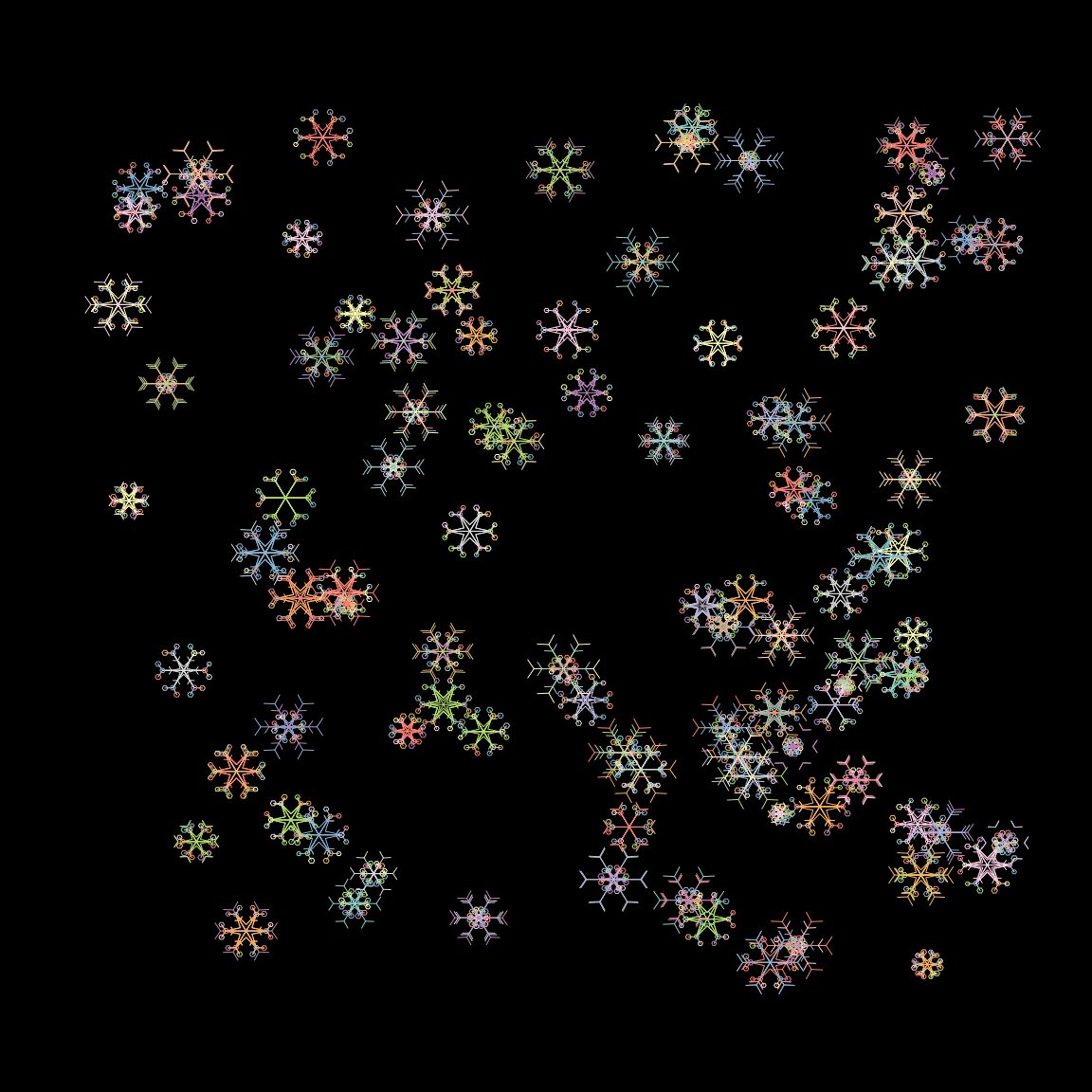
And here’s the output:
knitr::include_graphics("snowflakes_0.svg")
Authors
Senior Researcher in Cancer Genomics
I graduated with a degree in clinical medicine at the Jawaharlal Institute of Postgraduate Medical Education and Research, India. Following this, I obtained a Master of Science (by research) degree at the Indian Institute of Technology Madras; my research during this period focused on the role of microRNAs in the regulation of the Wnt signalling pathway. I studied for DPhil at the University of Oxford (2010-2014), in the Bone Oncology group headed by Dr. Claire Edwards. In my postdoctoral work, I worked on varied projects including high throughput screening, image and video analysis, and genomic analysis of prostate cancers. My recent work has been focused on studying tumour evolution and intra-tumour heterogeneity in prostate cancer, using spatial-omics tools developed by my group as well as the wider community. In addition to genomic analysis, we leverage foundation pathology models and spatial data frameworks developed by the community to develop a multi-modal understanding of prostate tumour biology.